
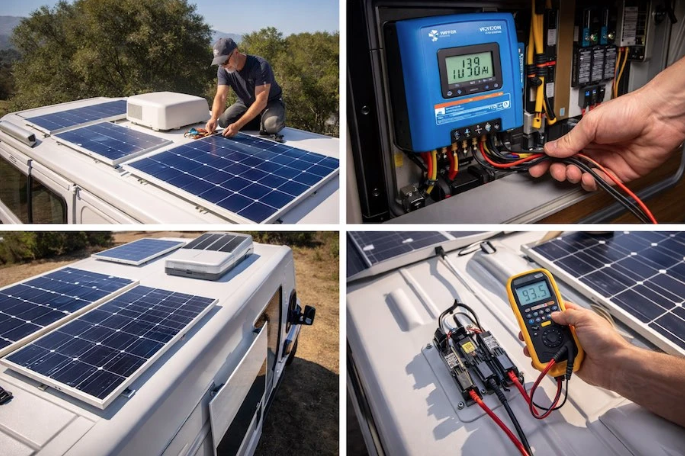
RV solar installation is often presented as a simple upgrade, but in reality it is a full system that has to work together: panels, charge controller, batteries, wiring, and how you actually use power day to day. Panels alone do nothing if the rest of the system is poorly planned.
A good solar setup feels invisible. A bad one constantly reminds you it exists.
Start with how you really use power
The biggest mistake in RV solar installation is starting with panel count instead of usage. Before choosing hardware, you need to understand what you run daily, how long you run it, and whether you camp mostly in sun or shade.
Lights, water pump, phone charging, and fans are easy. Microwaves, coffee makers, induction cooktops, and air conditioners change everything. Solar systems sized for weekend use fail quickly for full-time living if expectations are not realistic.
Solar works best when efficiency is prioritized before capacity.
Panels are only one part of the system
Roof-mounted panels get all the attention, but they are only the energy source. Without proper charge control and storage, extra panels are wasted.
Panel placement matters as much as panel size. Shadows from AC units, vents, or roof racks can dramatically reduce output. Flat-mounted panels are simple and durable, but tilting panels can improve winter performance if you are stationary.
More panels also mean more roof penetrations, which must be sealed correctly to avoid long-term leaks.
Charge controllers and why quality matters
The charge controller protects batteries and determines how efficiently solar energy is used. Cheap controllers often underperform or shorten battery life.
MPPT controllers are preferred for most RV solar installations because they extract more usable power, especially in partial shade or colder weather. Proper controller sizing is critical. Undersized controllers limit output. Oversized ones waste money but usually still work.
Controller location also matters. Poor ventilation leads to heat buildup and early failure.
Batteries define how useful solar really is
Solar power is only as good as your battery bank. If batteries fill up too quickly or drain too fast, solar feels disappointing no matter how many panels you have.
Lithium batteries have changed RV solar installations dramatically. They charge faster, tolerate deeper discharge, and perform better in daily use. Lead-acid batteries still work, but they require larger banks and more careful management.
Battery placement, ventilation, cable size, and protection are just as important as capacity.
Wiring, fusing, and safety
Solar wiring in an RV must handle vibration, heat, and moisture. Undersized cables cause voltage drop and heat. Poor routing causes chafing and failures months later.
Every part of the system must be fused correctly. This is not optional. Solar systems can deliver high current, and mistakes here create real fire risk.
Clean wiring and proper protection are signs of a professional installation, even if it is hidden from view.
Inverter integration
Most RV solar systems are paired with an inverter. The inverter size must match real loads, not wishful thinking. Running large inverters on small battery banks leads to constant low-voltage shutdowns and frustration.
Some installations power only selected outlets. Others feed the entire coach through a subpanel. Both approaches work when designed correctly.
Solar does not automatically mean you can run everything off-grid. Expectations must match system design.
When RV solar installation makes the most sense
Solar is ideal for boondocking, dry camping, and reducing generator use. It shines for people who value quiet, independence, and flexibility.
It is less effective for heavy air-conditioning use or shaded campgrounds unless the system is very large. Knowing these limits upfront prevents disappointment.
Professional RV solar installation matters
A poorly installed solar system can cause leaks, electrical issues, battery damage, and unreliable performance. This is why system design matters more than individual components.
Experienced specialists like Custom-way approach RV solar installation as a complete system. They evaluate roof layout, electrical capacity, battery setup, and real usage patterns before installing anything. This prevents common issues like undersized wiring, mismatched components, or systems that look good but underperform.
Practical takeaway
RV solar installation is not about covering the roof with panels. It is about building a balanced system that matches how you actually live and travel. When done right, solar quietly supports daily life without constant monitoring. When done wrong, it becomes an expensive lesson in poor planning.