
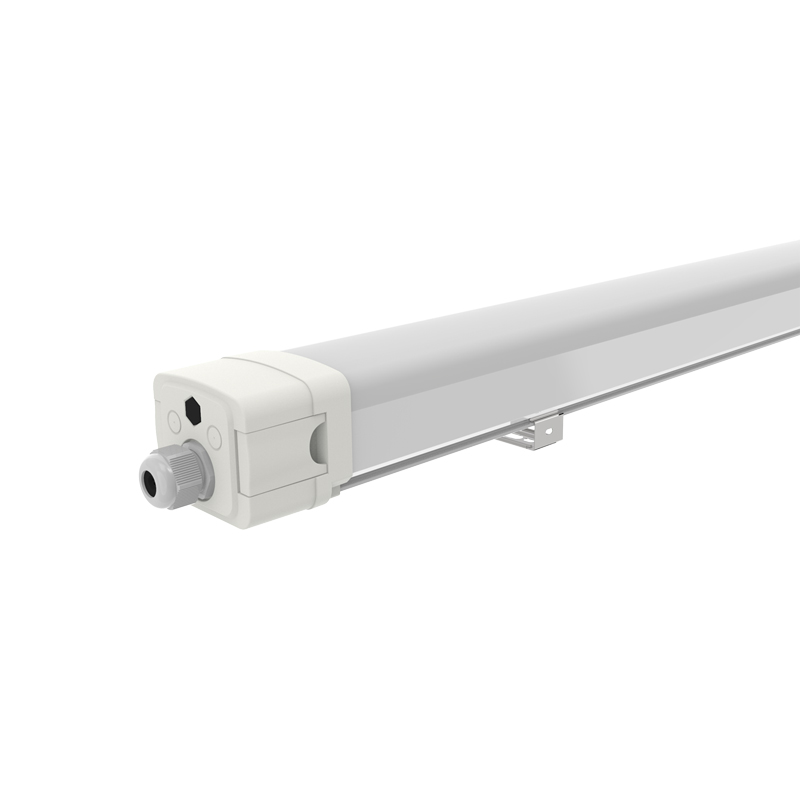
If you’ve searched how to wire a LED batten light fitting, this article covers it all: tools, parts of a batten, typical wiring schemes (single live, switched live, and linkable circuits), safety checks, and troubleshooting.
I’ll reference common COMLED-style features—surface-mount batten sizes (2FT/4FT/5FT), 18W/36W/44W variants, PC housings with milky diffusers, terminal blocks and sensor/emergency options—so you can match instructions to the actual product you have.
What’s in a LED batten light fitting
A batten fitting usually has: housing (PC or PC+coated steel), milky diffuser, LED strip/modules (SMD2835, LM-80 approved), driver (separate or clip-fixed), and a big terminal block for wiring.
Many COMLED battens have sensor dimming, emergency versions, and linkable connections — check the fixture label for input voltage (usually AC 220–240V) and polarity marks before you touch anything.
Tools and safety checklist before you start
- Tools: screwdriver (flat + Phillips), insulated wire strippers, voltage tester, small pliers, wire ferrules, and insulating tape.
- Materials: correctly rated cable, ferrules, and the batten’s big terminal block.
- Safety: switch off the circuit at the distribution board and check with a voltage tester. If anything is unclear on the product label or wiring diagram, contact COMLED’s technical/after-sales team.
- Note: many COMLED models have a clip-fixed driver and a big terminal block (5.0 mm hole size) to make wiring easy.
Typical wiring options — phrasing the keyword in headings
1) How to wire a LED batten light fitting for a single live circuit
Most common for corridors or storage rooms. You’ll use three conductors from the switch: Live (L), Neutral (N), and Earth (if available).
Steps (short form):
- Confirm power is OFF at the breaker and test with a tester.
- Strip ~8–10mm of cable insulation; fit ferrules if available.
- Connect supply Neutral to the batten Neutral terminal (N).
- Connect supply Live → switch → switched Live return → batten Live terminal (L).
- Connect Earth to the batten earth point if the fixture has one.6. Close terminals, clip the diffuser on, turn power back on, test.
Tip: many battens have a dedicated “switched live” terminal—use it instead of bridging neutrals.
2) How to wire a LED batten light fitting for permanent live (for sensor dimming)
Used when fitting an HF or microwave sensor so the sensor can detect presence and control dimming.
Key points:
- Feed permanent Live and Neutral to the batten’s sensor input (follow the product wiring diagram).
- Sensor output feeds the driver’s Live input.
- If the fixture supports 100%–20%–OFF HF sensor dimming (remote-set), make sure wiring matches the sensor model supplied with the batten.
- If in doubt, keep wiring tidy and note cable colours for future maintenance.
3) How to wire a linkable LED batten fitting (multiple fixtures)
Linkable battens let you chain luminaires from a single supply.
Procedure:
- Run the supply to the first batten, then connect from its link-out terminals to the next batten’s link-in.
- Respect maximum run length and wattage limits shown in the product manual (overloading the driver or wiring can cause failures).
- Many COMLED battens have dedicated link connectors to make this safe and repeatable.
Practical tips for neat, durable wiring
- Use the batten’s big terminal block: it’s designed to take thicker conductors and simplify joins.
- Keep live and neutral runs separate and don’t loop conductors under a single screw.
- Use wire ferrules on stranded conductors for reliable clamping.
- If the luminaire has a clip fixed driver, ensure the driver is fully seated and the clip is locked before powering on.
Common troubleshooting after wiring
- Fixture doesn’t light: check supply at breaker, verify neutral and live are not swapped, test the driver if removable.
- Flicker or intermittent light: check terminals and driver connection; ensure fixture is compatible with dimmer/sensor type.
- Sensor not working: confirm permanent live is present (if required) and sensor wiring matches fixture documentation.
Product match & customization notes (COMLED-style)
- If you need a vapor-tight option for tunnels or parking, check P-Series specs: IP65, IK08, milky PC diffuser, emergency and sensor options.
- For underground parking or workshops, consider L-Series/K-Series with IP66/IK10 and quick wiring caps—available in 18W/36W/44W sizes and linkable configurations.
- For applications that require split-type power supplies or self-test emergency, V-Series models often include that functionality.
If you need a custom sensor setting, emergency duration or different CCT (3000K/4000K/5000K/6000K), COMLED can do that—contact their technical/after-sales team for help.
Safety reminder — and where to get direct help
Wiring mains is serious business. If anything is unclear, wrong or you’re in a commercial installation, contact COMLED’s technical or after-sales team for the exact wiring diagram for your model. They can confirm driver wiring, sensor type compatibility and recommended installation practices for that specific batten.
Final checklist & next steps
- Power OFF and check.
- Check fixture label (input voltage, sensor/emergency options).
- Use ferrules, tightened terminals and secure cable entries.
- Test after closing the diffuser and record the wiring layout for maintenance.