
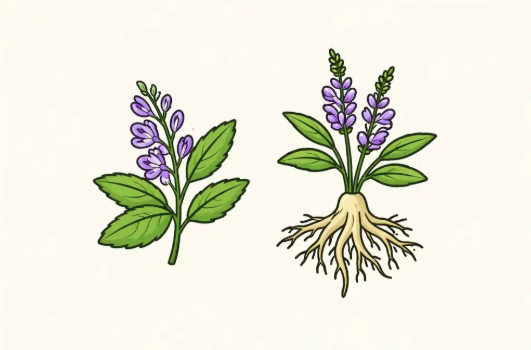
American Skullcap vs. Chinese Skullcap: Same Name, Different Plant, Different Use
American Skullcap vs. Chinese Skullcap is one of the most common “same common name, different plant” problems in herbal shopping. Two species share the word “skullcap,” but they are not interchangeable. American skullcap is Scutellaria lateriflora (typically aerial parts). Chinese skullcap is Scutellaria baicalensis (typically root, known in Traditional Chinese Medicine as Huang Qin).
This matters because the plant part, chemistry, tradition of use, and safety considerations differ. If you want to buy smarter, you need one skill: read the Latin binomial on the label and match it to your goal.
What is the real difference between American and Chinese skullcap?
American skullcap (Scutellaria lateriflora) is a North American Lamiaceae herb commonly used as a calming “nervine” style botanical in Western herbalism. Chinese skullcap (Scutellaria baicalensis) is an East Asian Lamiaceae herb whose root (Huang Qin) is widely used in Traditional Chinese Medicine and contains high levels of flavones such as baicalin, baicalein, and wogonin.
Why do so many people buy the wrong skullcap?
Common names collapse multiple species into one word
“Skullcap” is a catch-all for the genus Scutellaria. That’s helpful in casual conversation, but risky at checkout. A product can say “Skullcap” and still be the wrong species for what you intended. The fix is simple: always check the Latin name.
Plant part changes the product more than most people realize
American skullcap is usually sold as aerial parts (leaf/stem/flower). Chinese skullcap is usually sold as root. Different plant parts concentrate different compounds, and that changes flavor, extraction behavior, and typical formulations.
Adulteration and substitution are real in the supply chain
Skullcap has a known history of substitution or adulteration, including confusion with species that can raise safety concerns. This is why serious brands emphasize identity testing and publish documentation like COAs (Certificates of Analysis).
How do you read a skullcap label correctly?
Use this 10-second label rule
- Find the Latin name. You want Scutellaria lateriflora (American) or Scutellaria baicalensis (Chinese).
- Confirm the plant part. “Aerial parts” points toward American skullcap. “Root” points toward Chinese skullcap.
- Check the form. Tea/cut-and-sifted, tincture, capsule, or standardized extract.
- Check serving size clarity. Avoid vague “proprietary blend” listings if skullcap is your focus.
- Look for quality signals. Lot number, COA availability, third-party testing, and clear origin/sourcing language.
Know the two easiest “tell” words
- Huang Qin usually indicates Scutellaria baicalensis root.
- American skullcap usually indicates Scutellaria lateriflora aerial parts.
Educational note: If a product makes structure/function style claims, U.S. law requires the DSHEA disclaimer (“not intended to diagnose, treat, cure, or prevent any disease”) in the appropriate context. That disclaimer doesn’t prove quality, but it signals the product is marketed as a dietary supplement, not a drug.
What does each skullcap “feel like” in real-world use?
American skullcap is most often chosen for “busy mind” evenings
In Western herbal practice, Scutellaria lateriflora is commonly selected when people describe mental noise, tension, or difficulty settling down after a high-stimulation day. Think of it as a “routine herb” people add to an evening wind-down ritual. Human research exists, but it’s limited and not a license to expect a medical outcome.
Chinese skullcap is more often chosen as a targeted root extract in formulas
Scutellaria baicalensis root (Huang Qin) is deeply tied to Traditional Chinese Medicine pattern-based use and is often combined with other botanicals. In modern research, it’s frequently discussed through its flavone profile (baicalin, baicalein, wogonin). That chemistry is one reason it shows up in research literature more often than many “calm teas,” but most studies use extracts or isolated compounds rather than a simple tea.
Comparison table: American Skullcap vs. Chinese Skullcap
| Feature | American skullcap | Chinese skullcap |
| Latin name | Scutellaria lateriflora | Scutellaria baicalensis |
| Common alias | American skullcap, blue skullcap | Chinese skullcap, Huang Qin |
| Typical plant part sold | Aerial parts (leaf/stem/flower) | Root |
| Tradition of use | Western herbalism “nervine” style use | Traditional Chinese Medicine, often in formulas |
| Signature compounds (high-level) | Phenolics/flavonoids (profile differs by product) | Baicalin, baicalein, wogonin (well-described in literature) |
| Most common buying mistake | Buying “skullcap” without verifying species; quality varies | Buying aerial parts when you wanted root extract (or vice versa) |
| Safety headline | Pay attention to identity and adulteration risk | Potential interactions and liver safety context matter |
What does the research say, and what can’t it say?
American skullcap has limited but notable human data
A controlled human study in healthy volunteers has explored mood-related outcomes with Scutellaria lateriflora. That’s useful, but it’s not the same as proving a therapeutic effect for a diagnosed condition. Also, studies often use specific extracts or doses that don’t match a casual tea.
Chinese skullcap has a larger research footprint, mainly via its flavones
Scutellaria baicalensis appears frequently in pharmacology and phytochemistry literature. Reviews describe baicalin, baicalein, and wogonin as key constituents. Still, many papers are preclinical, and when human data exists, it may involve mixed formulas or standardized extracts—not a home brew.
Safety research often highlights product complexity, not just the herb
When liver injury is reported in association with “skullcap,” cases frequently involve multi-ingredient products, uncertain sourcing, or adulteration. That’s why quality controls (identity testing, contaminant testing, and transparent documentation) are not “nice to have.” They are the whole game.
Why label-reading matters
Dietary supplements are mainstream. In U.S. survey data from 2017–2018, about 57.6% of adults reported using a dietary supplement in the past 30 days. When so many people shop this category, species-level confusion becomes a population-scale problem, not a rare mistake.
Adulteration is measurable
Large DNA-barcoding research across commercial herbal products has reported measurable adulteration rates in certain datasets (one large study cited a 4.2% adulteration rate among successfully barcoded samples). The exact rate varies by market and method, but the direction is clear: identity verification matters.
Buying mistakes to avoid (and what to do instead)
Buying “Skullcap” without the species name
Do instead: Only buy products that list Scutellaria lateriflora or Scutellaria baicalensis clearly. If the label hides the species, treat it as a red flag.
Assuming all skullcap products are calming “sleep herbs”
Do instead: Match the skullcap type to the tradition and product form. American skullcap commonly shows up in calming blends. Chinese skullcap root is often positioned differently and may be part of more complex formulas.
Ignoring plant part
Do instead: If you want American skullcap “tea-style,” choose aerial parts. If you want Chinese skullcap “Huang Qin” context, look for root-based products and clear standardization or sourcing notes.
Skipping quality documentation
Do instead: Prefer brands that can provide a recent COA, show identity testing, and state contaminant testing (heavy metals, microbes, pesticides, residual solvents where relevant). This is especially important for roots and concentrated extracts.
Quality checklist for skullcap products
- Species listed: Scutellaria lateriflora or Scutellaria baicalensis (not just “skullcap”).
- Plant part listed: aerial parts vs root.
- Identity testing: at least one validated method (organoleptic + microscopy + chromatography; DNA methods can help in some contexts).
- Contaminant testing: heavy metals, microbes; pesticides where relevant.
- Lot traceability: batch/lot number, manufacturing details.
- Transparent dosing: clear mg amounts per serving; minimal “proprietary blend” opacity.
- Reasonable claims: structure/function language without disease claims; proper DSHEA disclaimer where applicable.
FAQ
Are American skullcap and Chinese skullcap the same herb?
No. They are different species: Scutellaria lateriflora (American) and Scutellaria baicalensis (Chinese).
What is the easiest way to avoid buying the wrong one?
Check the Latin name and plant part. “Skullcap” alone is not enough.
Which one is Huang Qin?
Huang Qin is Scutellaria baicalensis root, used in Traditional Chinese Medicine.
Can I use either skullcap the same way?
Do not assume that. The chemistry and traditional contexts differ, and product forms vary widely.
Is skullcap always safe because it’s “natural”?
No. Safety depends on the species, dose, product quality, and your medications or conditions. Use extra caution with multi-ingredient blends and consider clinician guidance if you have health conditions.
Why do some sources mention liver issues with skullcap?
Reports often involve complex products, uncertain identity, or adulteration. That’s why identity testing and quality documentation matter.
Glossary
Scutellaria lateriflora
American skullcap; commonly sold as aerial parts.
Scutellaria baicalensis
Chinese skullcap; commonly sold as root (Huang Qin).
Huang Qin
Traditional name for Chinese skullcap root in TCM contexts.
Binomial nomenclature
The two-part Latin species name (genus + species), used to prevent common-name confusion.
Aerial parts
Non-root plant material such as leaf, stem, and flower.
Standardized extract
An extract adjusted to contain a consistent level of specific marker compounds.
COA (Certificate of Analysis)
A lab document showing identity and contaminant test results for a specific batch.
Adulteration
Substitution or contamination of an herbal ingredient with another species or material.
Baicalin / Baicalein / Wogonin
Well-described flavones associated with Scutellaria baicalensis root.
Conclusion
American Skullcap vs. Chinese Skullcap is not a small naming detail—it’s the difference between two species with different parts, chemistry, and use traditions. Read the Latin name, verify the plant part, and buy based on documentation, not vibes.
Sources used
- Human study on American skullcap mood outcomes: Brock C. et al. “American Skullcap (Scutellaria lateriflora): a randomised placebo-controlled crossover study in healthy volunteers.” (PubMed record).
- Chinese skullcap (Huang Qin) history, root use, Chinese Pharmacopoeia mention: Zhao Q. et al. “Scutellaria baicalensis, the golden herb…” (NIH/PMC).
- Major constituents of Scutellaria baicalensis (baicalin/baicalein/wogonin): Li-Weber M. “The anticancer properties of Scutellaria and its main active constituents…” (PubMed).
- Chinese skullcap overview (Huang Qin naming and clinical context): Memorial Sloan Kettering Cancer Center. “Scutellaria baicalensis” monograph (2022).
- Skullcap adulteration notes and phenolic profile comparison; Teucrium adulterants: Lin LZ. et al. “Comparison of the Phenolic Component Profiles of Skullcap…” (NIH/PMC).
- Skullcap adulteration and toxicity context; quality/identity standards: American Herbal Pharmacopoeia (AHP) “Skullcap Aerial Parts” ordering/overview page; plus Upton R. “Scutellaria lateriflora L.: An American nervine.” (ScienceDirect abstract).
- Liver injury overview for skullcap; safety context: NIH LiverTox “Skullcap” entry (NCBI Bookshelf) and NIH/PMC review “Insights into skullcap herb-induced liver injury.”
- Dietary supplement usage statistic (57.6% of adults, 2017–2018): CDC/NCHS Data Brief No. 399 “Dietary Supplement Use Among Adults” (2021).
- DNA barcoding/adulteration statistic example (4.2% in a large barcoding dataset): Ichim MC. “The DNA-Based Authentication of Commercial Herbal Products…” (NIH/PMC, 2019) summarizing Han et al. dataset.
- FDA rules and DSHEA disclaimer for structure/function claims: U.S. FDA “Structure/Function Claims” and FDA “Questions and Answers on Dietary Supplements” pages; 21 CFR 101.93 and FDA “Letter to the Dietary Supplement Industry on the DSHEA Disclaimer” (2025).