


Introduction: The Challenge of Fiber Exhaust
In metropolitan networks, expansive campus backbones, and growing enterprise data centers, a silent crisis often emerges: fiber exhaust. Conduits fill up, dark fiber leases become prohibitively expensive, and the physical capacity of installed cables seems to hit a hard limit long before the need for bandwidth plateaus. Deploying new fiber infrastructure is a major capital project. The 10G BiDi SFP+ transceiver emerged as an elegant, software-transparent solution to this problem, effectively doubling the capacity of an existing single-mode fiber plant and postponing the need for new fiber installations indefinitely.
Technical Mechanics: How BiDi Transceivers Break the Duplex Paradigm
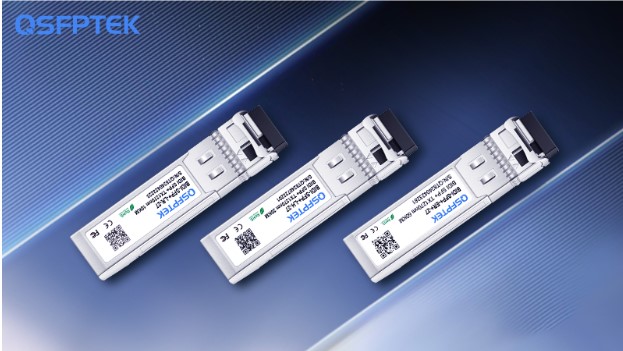
Traditional optical transceivers, from 1G to 400G, rely on a duplex design: one fiber for transmit (Tx) and a separate fiber for receive (Rx). A Bidirectional (BiDi) SFP+ upends this model. It transmits and receives optical signals over a single strand of standard single-mode fiber (SMF).
This technological feat is accomplished through Wavelength-Division Multiplexing (WDM). Each 10G BiDi SFP+ module is equipped with a specialized WDM coupler. It transmits data on one specific wavelength (e.g., 1270 nm) and receives on a different, distinct wavelength (e.g., 1330 nm) over that same fiber. Crucially, these modules are deployed in complementary matched pairs. If Module A transmits at 1270nm and receives at 1330nm, then Module B at the opposite end of the link must be configured to transmit at 1330nm and receive at 1270nm. Common wavelength pairs include 1270/1330nm, 1310/1550nm, and 1490/1550nm, with the choice often dictated by compatibility with existing WDM systems or to avoid interference.
Unrivaled Advantages in Fiber-Constrained Environments
- Immediate 50% Fiber Savings: This is the transformative benefit. A link that previously consumed two fibers now uses only one. This instantly frees up half of a fiber bundle for future expansion or other services.
- Significant Cost Reduction: The savings are multi-faceted: avoidance of new fiber trenching and installation costs, reduced costs for patch panels and cable management hardware (since simplex cables are used), and lower leasing fees for dark fiber where only one strand is needed per link instead of a pair.
- Simplified Network Design and Management: Using simplex fiber cables reduces physical clutter in fiber distribution frames, simplifying tracing, testing, and maintenance. It also allows for more elegant network designs in space-constrained points of presence (POPs).
Diverse Application Landscapes
- Metropolitan Area Networks (MAN) and Service Provider Backhaul: Connecting central offices, cell towers (4G/LTE/5G mid-haul), and customer premises where fiber pairs are scarce and expensive to lease.
- Enterprise Campus and Building Backbones: Interconnecting buildings or floors using existing, limited-count fiber cables that were initially installed for 1G or 100BASE-FX.
- Fiber-to-the-Home (FTTH) Backhaul: Aggregating traffic from multiple passive optical network (PON) terminals back to the central office.
- Data Center Interconnect (DCI) for Short Distances: For cost-sensitive DCI links under 10-20 km where installing new fiber is not feasible.
- Migrating from Legacy TDM to Ethernet: Allows carriers to replace older SONET/SDH equipment using single-fiber interfaces with modern 10G Ethernet over the same physical path.
Best Practices for Deployment
Successful deployment requires careful planning:
- Wavelength Planning: Ensure matched pairs are ordered and clearly labeled (e.g., “1270nm Tx / 1330nm Rx” and “1330nm Tx / 1270nm Rx”).
- Link Loss Budget Calculation: Use the specific transmit power and receiver sensitivity for the chosen wavelength pair. Remember, the link loss is the total loss on the single fiber for both directions.
- Documentation: Meticulously document which wavelength is used on each fiber strand and at each patch panel. This is critical for future troubleshooting and adds.
Conclusion: A Proven Strategy for Sustainable Growth
The 10G BiDi SFP+ transceiver is a cornerstone technology for network sustainability. It demonstrates that innovation isn’t always about raw speed increases; sometimes, it’s about using existing resources with far greater intelligence and efficiency. By making every strand of fiber work twice as hard, it provides network operators with a powerful, reliable, and standards-compliant tool to scale their networks gracefully, control costs, and navigate the challenge of fiber exhaust. It remains an essential component in the toolkit of any network engineer tasked with extending the life and capacity of a legacy fiber infrastructure.